
EXAMPLE: “The Cafeteria Scene” (Episode opens)
[0:00-0:35] Full Scene Setup
[Show complete scene with subtitles]
Mary: “Look at him. Breaks my heart.”
George: “Poor little guy, all alone.”
Mary: “I don’t see why his brother can’t sit with him.”
George: “Come on, Mary. When you were in high school, would you have lunch with a nine-year-old?”
Mary: “Yes, I would’ve.”
George: “Well, there’s something wrong with you.”
Mary: “I’m gonna keep him company.”
George: “Hey, hey, hey, Mary. Mary. Think this through. Right now the kids are just ignoring Sheldon. What happens if he’s sitting with his mommy?”
[Pause clip]
[0:35-1:10] Context Frame
“Okay, stop. This 40-second scene is PACKED with real English. Mary’s heart is breaking watching her kid eat alone. George knows she’s about to make it worse. There’s worry, there’s teasing, there’s a husband stopping his wife from doing something stupid. This is a masterclass in family dynamics.
We’re gonna break down five phrases here, but they’re not random—they’re all working together to show concern, give warnings, and handle emotion. Let’s start with the most powerful one…”
[1:10-2:40] Phrase 1: “Breaks My Heart” (90 sec)
[Block 1: Clip + Hook – 15 sec]
“Mary says: ‘Breaks my heart.’ Not ‘makes me sad,’ not ‘I feel bad’—breaks my heart. Watch her face when she says it.”
[Show clip of just that moment]
[Block 2: Function – 25 sec]
“This phrase has ONE job: turn emotional pain into physical pain. You’re saying the feeling is so strong, it’s literally damaging your heart. English loves body metaphors—gut-wrenching, spine-chilling, heartbreaking. This is the most powerful one. It’s NEVER casual, NEVER sarcastic.”
[Block 3: Examples + Tone – 40 sec]
“The tone is soft, caring. Sometimes people put their hand on their chest. Try it: ‘It breaks my heart when I see elderly people eating alone.’ Feel that? Now try dropping the ‘it’ like Mary did—’Breaks my heart.’ More emotional, right? That’s what natives do when the feeling is really strong.
Here’s another: ‘Seeing you cry like that… breaks my heart.’ You can even pause before it for emphasis.”
[Block 4: Warning – 10 sec]
“Never, ever use this sarcastically. If you say ‘Oh, you failed your test? Breaks my heart’ with an eye roll, people will think you’re a sociopath. This is genuine emotion only. Got it? Okay, next phrase…”
[2:40-4:10] Phrase 2: “Poor Little Guy” (90 sec)
[Block 1: Clip + Hook – 15 sec]
“George adds: ‘Poor little guy, all alone.’ This is pure sympathy language. Let’s break it down…”
[Block 2: Function – 25 sec]
“This phrase shows sympathy without being dramatic. It’s softer than ‘breaks my heart’—more like ‘I feel bad for them.’ The word ‘little’ makes it extra sympathetic, even if the person isn’t physically small. You’re showing they’re vulnerable.”
[Block 3: Examples + Variations – 40 sec]
“You can adjust this: ‘Poor little guy’ for males, ‘Poor thing’ for anyone, ‘Poor baby’ when you’re being very sympathetic—but careful, ‘poor baby’ to an adult can sound condescending.
Try these: Your dog is sick—’Aww, poor little guy.’ Your friend got dumped—’Poor thing, I’m so sorry.’ A kid falls down—’Ohhh, poor baby!’ See how the tone changes slightly each time?”
[Block 4: Warning – 10 sec]
“This is always genuine. You CAN say it about yourself as a joke—’I’m so tired, poor me!’—but even that needs a light, self-aware tone. Next…”
[4:10-5:40] Phrase 3: “Come On” (90 sec)
[Block 1: Clip + Hook – 15 sec]
“George says: ‘Come on, Mary.’ Two words, but watch his tone—he’s trying to talk sense into her. This phrase is incredibly versatile…”
[Block 2: Function – 25 sec]
“In this scene, it means ‘be realistic’ or ‘you know better than that.’ But ‘come on’ changes meaning based on tone:
- Persuasion: ‘Come on, just try it!’
- Disbelief: ‘Come on, you don’t believe that…’
- Encouragement: ‘Come on, you got this!’
- Frustration: ‘Oh, come ON!’ (stress the ON)
George is using the ‘be realistic’ version—gentle but firm.”
[Block 3: Examples + Tone Practice – 40 sec]
“Let’s practice all four tones. Repeat after me:
- PERSUASION: ‘Come on, one more episode!’ (light, friendly)
- DISBELIEF: ‘Come on, that can’t be true…’ (skeptical, falling tone)
- ENCOURAGEMENT: ‘Come on, you can do it!’ (energetic, supportive)
- FRUSTRATION: ‘Oh, come ON!’ (sharp, stressed ON)
Native speakers blend this super fast: /kə-MON/ or just ‘C’mon.’ Try it three times faster each time!”
[Block 4: Warning – 10 sec]
“The frustration version can sound rude if overused. Use it with strangers carefully. With friends and family? Go nuts. Moving on…”
[5:40-7:10] Phrase 4: “Think This Through” (90 sec)
[Block 1: Clip + Hook – 15 sec]
“Here’s the key moment. George stops Mary: ‘Think this through. Right now the kids are just ignoring Sheldon. What happens if he’s sitting with his mommy?’ He’s forcing her to see the future consequences. Let’s break down this power phrase…”
[Block 2: Function – 25 sec]
“This phrase does one thing: consequence mapping. You’re telling someone to play the movie forward—not just Step 1, but Step 2, Step 3, all the way to the painful ending. It’s a mental stop sign that says ‘Map the path before you walk it.’ George literally demonstrates it—he asks ‘What happens if…?’ That’s the function in action.”
[Block 3: Examples + Application – 40 sec]
“Use this BEFORE someone acts, never after—that’s just ‘I told you so.’
Examples:
- Friend wants to text their ex: ‘Think it through—what happens when they respond? Then what?’
- You’re about to buy something expensive: ‘Think it through—can I afford this next month?’
- Professional context: ‘The plan looks good, but think it through for Q3 budget implications.’
Native pronunciation: ‘thinkith-THRU’—fast, blended. Try it!”
[Block 4: Warning – 10 sec]
“Don’t use this with your boss about THEIR decision—sounds condescending. Don’t use it after someone already decided—sounds smug. Use it DURING the decision-making process. Last phrase…”
[7:10-8:20] Phrase 5: “There’s Something Wrong with You” (70 sec)
[Block 1: Clip + Hook – 10 sec]
“George teases Mary: ‘Well, there’s something wrong with you.’ He’s joking, but this phrase is DANGEROUS if you misuse it…”
[Block 2: Function – 20 sec]
“In this context, it’s playful teasing between a married couple. George is saying ‘you’re weird’ in an affectionate way. But take this phrase out of a close relationship, and it becomes an insult. The function is ONLY appropriate with people who know you’re joking.”
[Block 3: Safe Zones vs. Danger Zones – 30 sec]
“✅ SAFE: Close friends, family members, when someone says something silly
❌ DANGER: New acquaintances, coworkers, anyone who might take it literallySafer alternatives:
- ‘You’re so weird!’ (lighter)
- ‘What’s wrong with you?!’ (said while laughing)
- ‘You need help!’ (clearly joking tone)
The key is: your relationship + your tone + their sense of humor. All three must align.”
[Block 4: Warning – 10 sec]
“When in doubt, DON’T use this. It’s too risky. There are a hundred safer ways to tease someone. Only use it if you’re 100% sure they’ll laugh. Okay, let’s put this all together…”
[8:20-9:50] Scene Replay + Understanding Check (90 sec)
“Alright, let’s watch that scene again. This time, you understand EVERY phrase, EVERY tone, EVERY function. Watch how they all work together…”
[Replay full scene with NO interruption]
“See that? Mary expresses emotion—’breaks my heart.’ George validates it—’poor little guy’—then immediately pivots to reality—’come on’—then forces her to map consequences—’think this through.’ And when she insists, he teases her—’there’s something wrong with you.’
Five phrases. One scene. Complete emotional journey. That’s how native English actually works—phrases don’t exist in isolation. They’re tools in a conversation.”
[9:50-11:20] Spiral Practice Challenge (90 sec)
“Your turn. I’m gonna give you a scenario, and you’re gonna use at least THREE of these phrases. Ready?
Scenario: Your friend wants to quit their job after one bad meeting with their boss. They’re venting to you. What do you say?
Pause and try it out loud… Done? Okay, here’s how I’d do it:
‘I know you’re frustrated—poor thing, that meeting sounds awful. But come on, one bad day doesn’t mean quit, right? Think this through—you’ve been there three years, you love your team, and you need the insurance. What happens if you quit today and regret it tomorrow? If you still want to quit next month, I’ll support you. But breaks my heart to see you throw away something good because of one jerk boss.’
I used FOUR phrases naturally. They flowed because they all serve the conversation—sympathy, reality check, consequence mapping, emotion. That’s the goal.
Now YOU try again with a different scenario: Your roommate wants to adopt a dog but works 12-hour days. Use three phrases. Go!”
[11:20-12:00] CTA + Next Episode Tease (40 sec)
“That’s the Cafeteria Scene. Five phrases, one complete breakdown. Here’s your homework: watch one real conversation this week—a TV show, a movie, YouTube, whatever—and try to identify when someone uses ANY of these five phrases. You’ll start seeing them everywhere.
Next video: we’re breaking down the Library Scene where Sheldon tries to make friends using a self-help book. You’ll learn ‘having a hard time,’ ‘you and me both,’ and the MOST versatile phrase in English—’what’s going on?’ Three tones, three meanings, one phrase.
See you there!”
Young Sheldon S01E02 – Complete Scene Breakdown & Phrase Mapping
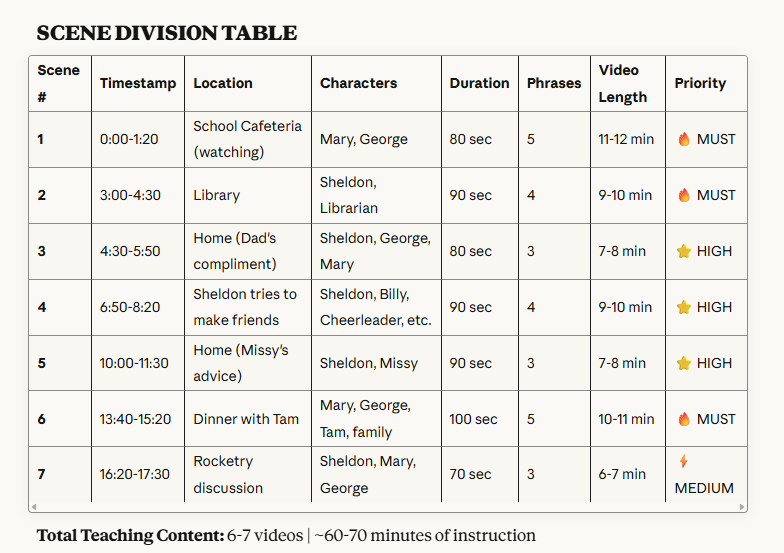
Episode Overview
Episode: S01E02 (Second episode, Season 1)
Total Runtime: ~18 minutes (without intro/credits)
Total Teachable Phrases: 27+ high-value phrases
Recommended Videos: 6-7 scene breakdowns
DETAILED SCENE BREAKDOWN
SCENE 1: The Cafeteria (0:00-1:20)
🔥 PRIORITY: MUST-TEACH | Video Length: 11-12 minutes
Context:
Mary and George watch Sheldon eat lunch alone. Mary wants to sit with him; George stops her. High emotional stakes + practical wisdom.
Phrases to Teach (5):
- “Breaks my heart” ❤️🩹
- Function: Physical pain metaphor for emotional suffering
- Tone: Soft, genuine, hand-on-heart
- Difficulty: Beginner
- Teaching time: 90 sec
- “Poor little guy” 🥺
- Function: Expressing sympathy without drama
- Tone: Soft, caring
- Difficulty: Beginner
- Teaching time: 90 sec
- “Come on” 🤨
- Function: Four meanings (persuasion, disbelief, encouragement, frustration)
- Tone: Variable – must teach all four
- Difficulty: Intermediate
- Teaching time: 90 sec
- “Think this through” 🧠
- Function: Consequence mapping before action
- Tone: Firm but caring
- Difficulty: Intermediate
- Teaching time: 90 sec
- “There’s something wrong with you” 😏
- Function: Playful teasing (DANGER ZONES!)
- Tone: Light, joking (context-dependent)
- Difficulty: Advanced
- Teaching time: 70 sec
Why Teach This Scene First:
- ✅ High emotional engagement (parent watching lonely child)
- ✅ Mix of beginner + intermediate phrases
- ✅ Shows phrase interaction (sympathy → reality check → warning)
- ✅ Relatable scenario (family concern + practical advice)
Spiral Practice Scenario:
“Your friend wants to quit their job after one bad meeting. Use 3+ phrases.”
SCENE 2: The Library (3:00-4:30)
🔥 PRIORITY: MUST-TEACH | Video Length: 9-10 minutes
Context:
Sheldon asks the librarian for help making friends. Sweet, vulnerable moment with excellent empathy language.
Phrases to Teach (4):
- “Having a hard time” 😰
- Function: Kindest way to say “struggling”
- Tone: Empathetic, gentle
- Difficulty: Beginner
- Teaching time: 90 sec
- “You and me both” 🤝
- Function: Bonding over shared struggle (TONE CRITICAL!)
- Tone: Must add warmth or sound robotic
- Difficulty: Intermediate
- Teaching time: 90 sec
- “What can I get for you today?” 🛎️
- Function: Service industry greeting / offering help
- Tone: Friendly, helpful
- Difficulty: Beginner
- Teaching time: 60 sec
- “It’s been around a while” 📚
- Function: Describing something old but still relevant
- Tone: Neutral, factual
- Difficulty: Beginner
- Teaching time: 60 sec
Why Teach This Scene Second:
- ✅ Builds on emotional vocabulary from Scene 1
- ✅ All phrases are empathy/social connection focused
- ✅ Natural transition: family concern → social struggle
- ✅ Introduces “you and me both” (connects to Scene 1’s themes)
Spiral Practice Scenario:
“Your coworker is struggling with a project. Show empathy using all 4 phrases.”
SCENE 3: Home – Dad’s Compliment (4:30-5:50)
⭐ PRIORITY: HIGH | Video Length: 7-8 minutes
Context:
Sheldon practices Dale Carnegie principles on George. Awkward but hilarious social skills practice.
Phrases to Teach (3):
- “What’s going on?” 🤔
- Function: THREE different meanings (worried/curious/angry)
- Tone: MUST teach all three with demos
- Difficulty: Intermediate
- Teaching time: 90 sec
- “Good for you” 👍/🙄
- Function: Genuine praise vs. sarcasm (THE BIG SWITCH!)
- Tone: Two opposite deliveries
- Difficulty: Advanced
- Teaching time: 90 sec
- “I suppose” 🤷
- Function: Reluctant agreement / not fully convinced
- Tone: Hesitant, uncertain
- Difficulty: Intermediate
- Teaching time: 60 sec
Why Teach This Scene Third:
- ✅ Introduces tone-switching (sarcasm vs. genuine)
- ✅ Builds on conversation skills from Scene 2
- ✅ Shorter scene = good pacing variety
- ✅ High comedy value = engagement boost
Spiral Practice Scenario:
“Someone tells you surprising news. Use ‘What’s going on?’ and ‘Good for you’ with different tones.”
SCENE 4: Making Friends Montage (6:50-8:20)
⭐ PRIORITY: HIGH | Video Length: 9-10 minutes
Context:
Sheldon tries (and fails) to make friends using the book. Multiple quick interactions showing social awkwardness.
Phrases to Teach (4):
- “Are you by any chance…?” 🎩
- Function: Polite stranger approach
- Tone: Formal, courteous
- Difficulty: Intermediate
- Teaching time: 90 sec
- “Go [Team Name]” 📣
- Function: Sports enthusiasm / team support
- Tone: Energetic (or awkward if forced)
- Difficulty: Beginner
- Teaching time: 60 sec
- “Would you like to…?” 💬
- Function: Polite invitation/offer
- Tone: Friendly, open
- Difficulty: Beginner
- Teaching time: 60 sec
- “I don’t think so” 🚫
- Function: Polite rejection
- Tone: Firm but not rude
- Difficulty: Intermediate
- Teaching time: 60 sec
Why Teach This Scene Fourth:
- ✅ Practical social English (approaching strangers)
- ✅ Shows what NOT to do (via Sheldon’s failures)
- ✅ Prepares for Scene 6 (successful friend-making)
- ✅ Mix of polite formality + casual expressions
Spiral Practice Scenario:
“You want to start a conversation with someone at a networking event. Use ‘Excuse me’ + ‘Are you by any chance…?'”
SCENE 5: Missy’s Advice (10:00-11:30)
⭐ PRIORITY: HIGH | Video Length: 7-8 minutes
Context:
Missy gives Sheldon genius advice about the library card. Sibling dynamics + problem-solving.
Phrases to Teach (3):
- “How come?” 🤷♀️
- Function: Casual “why?” (softer, curious)
- Tone: Curious, never aggressive
- Difficulty: Beginner
- Teaching time: 90 sec
- “That’s the saddest thing I’ve ever heard” 😢
- Function: Exaggerated sympathy/reaction
- Tone: Can be genuine or mildly sarcastic
- Difficulty: Intermediate
- Teaching time: 90 sec
- “So?” 🤨
- Function: “What’s your point?” or “Tell me more”
- Tone: Variable (curious vs. dismissive)
- Difficulty: Intermediate
- Teaching time: 60 sec
Why Teach This Scene Fifth:
- ✅ Lighter, sibling-focused (different dynamic)
- ✅ “How come” is essential casual English
- ✅ Shows problem-solving conversation
- ✅ Good pacing break before intense dinner scene
Spiral Practice Scenario:
“Your sibling/friend makes an unusual decision. Use ‘How come?’ and respond to their explanation.”
SCENE 6: Dinner with Tam (13:40-15:20)
🔥 PRIORITY: MUST-TEACH | Video Length: 10-11 minutes
Context:
Tam comes for dinner. Awkward cultural/social navigation. George’s Vietnam comments. The RICHEST scene for natural conversation.
Phrases to Teach (5):
- “What brings you to…?” 🗺️
- Function: Asking someone’s reason for being somewhere
- Tone: Friendly, conversational
- Difficulty: Intermediate
- Teaching time: 90 sec
- “I was trying to…” 🤷
- Function: Explaining good intentions when things go wrong
- Tone: Apologetic, explaining
- Difficulty: Intermediate
- Teaching time: 90 sec
- “That’s too bad” 😔
- Function: Polite sympathy (safer than “that sucks”)
- Tone: Sympathetic but restrained
- Difficulty: Beginner
- Teaching time: 60 sec
- “You gonna put a good spin on that one?” 😏
- Function: Calling out forced optimism
- Tone: Sarcastic challenge
- Difficulty: Advanced
- Teaching time: 90 sec
- “Well, that was depressing” 😐
- Function: Stating the obvious uncomfortable truth
- Tone: Deadpan, understated
- Difficulty: Intermediate
- Teaching time: 60 sec
Why Teach This Scene Sixth:
- ✅ Most complex social dynamics (formal dinner + cultural tension)
- ✅ Shows polite conversation + awkward moments
- ✅ Builds on all previous social skills
- ✅ High rewatch value (awkward humor)
Spiral Practice Scenario:
“You’re at dinner with someone new. Things get awkward. Navigate using 3+ phrases.”
SCENE 7: Rocketry Discussion (16:20-17:30)
⚡ PRIORITY: MEDIUM | Video Length: 6-7 minutes
Context:
Sheldon asks to resume rocketry. Mary and George negotiate. Shows persuasion tactics.
Phrases to Teach (3):
- “We’ve been through this” 😤
- Function: “We’ve discussed this many times already”
- Tone: Tired, frustrated parent/teacher
- Difficulty: Intermediate
- Teaching time: 90 sec
- “Tell that to…” 🙄
- Function: Sarcastic reality check
- Tone: Sardonic, pointing out consequences
- Difficulty: Advanced
- Teaching time: 90 sec
- “Hang on” ✋
- Function: “Wait a moment” (pause the conversation)
- Tone: Quick, attention-grabbing
- Difficulty: Beginner
- Teaching time: 60 sec
Why Teach This Scene Last:
- ✅ Shorter, focused scene
- ✅ Shows parent-child negotiation
- ✅ Reinforces “consequence mapping” from Scene 1
- ✅ Natural series conclusion
Spiral Practice Scenario:
“Someone keeps asking for something you’ve already said no to. Use ‘We’ve been through this’ + ‘Tell that to…'”